

Killers and Sympathizers
The Hollywood Redemption of the White Male

This is my review of Killers of the Flower Moon one year later. Maybe I think too much or maybe this film was unconscious propaganda. Either way, so I write.
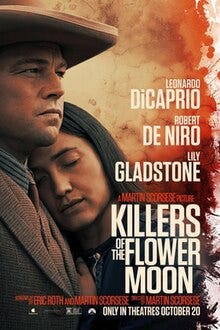
Killers of the Flower Moon by Martin Scorsese was a tragically beautiful Western crime epic that retold the story of the 1920s Osage murders. The series of murders were done in a bid to strip the Osage, a tribe of Native Americans, of their wealth for redistribution among white men who masqueraded as their country-folk, friends and lovers.
The film features various complex characters but the one who still stands out to me months after its release is Ernest Burkhart, played by Leonardo DiCaprio. Ernest was a white man who, under the counselling of his uncle, Willian King Hale (Robert DeNiro), acted as a hitman who participated in the death of various Osage women and men. Despite his many moral and civil crimes such as serial murder, including that of his sisters-in-law, poisoning his wife and orchestrating a bomb explosion, DiCaprio’s Ernest is portrayed as a very conflicted and downright stupid young man who is simply manipulated by his uncle into being a terrorist.
While this on again, off again portrayal of humanity was showcased throughout the production, I felt a particular chill when, towards the end of the film, particularly at the two hour forty minute mark, Ernest reinvents himself. He now assumes the position of a redeemed delinquent, horrified at his own deeds and desperate for the forgiveness of his diabetic wife (who just barely survived his insulin poisoning).
That Backstory Hit Though
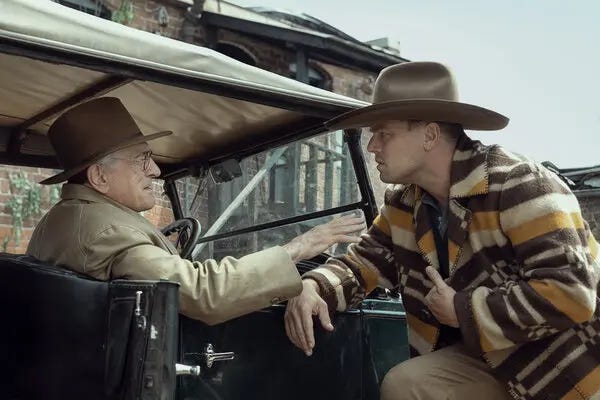
Going on nothing but Scorsese’s retelling of this real-life story, we first follow Ernest from the moment he returned to Oklahoma in the 1920s after the first World War. He’s reunited with his brother, Byron, and Hale, who was widely considered a friend to the Osage people, even speaking their language. While working as a driver, Ernest meets Mollie Kyle (Lily Gladstone) an Osage woman whose family owns oil headrights. Hale convinces Ernest to marry Mollie as a ‘smart investment’. Together, Ernest and Hale, aided by other white male characters, plan and execute a series of murders against Mollie’s relatives, including her sisters and mother, so Mollie will own all the headrights which will eventually fall to Ernest after her death.
Mollie is diabetic and with the help of similarly racist and greedy doctors, Hale and Ernest poison her insulin, which nearly kills her. With corrupt officials filling up positions of authority, Mollie can only travel to Washington D.C. to directly ask the president for help who sends the newly formed FBI to investigate the case of the Osage deaths.
Looking at the characters that DiCaprio has played in the past, he has rarely ever fit into either of the binary roles of good or evil. Whether it was portraying an obsessive lovesick philanthropist in The Great Gatsby or a desperate stockbroker in the Wolf of Wall Street, DiCaprio has a knack for the complex and we, the viewers, see the height of it in Killers of the Flower Moon. I liked the technical aspects of the film, from production design to cinematography, plus the performances from the leading cast. However, its direction rises alarm bells for me and makes me question if Scorsese is so insightful as a director with an affinity for understanding the human complex or if he, as a hubris, is simply and inevitably just a white man with a skewed view of the world.
When the FBI get involved in the Osage murder cases, Hale meets with Ernest to clear some things up. In standard manipulative form, he scares Ernest with the possibility of being charged, then assures Ernest that his lawyers will protect him. To soothe Ernest’s alarm, Hale asks if he’s been giving his wife ‘her shots’ and reminds him that he needs to give her all of it. Ernest replies that he’d doing what he’s supposed to be doing, confirming that ‘she’s quiet’. Seven minutes later, we see Ernest with Mollie who is so sick she can’t keep her eyes open. In the next frame, as Ernest prepares her shots, he dumps a few drops out into his glass and drinks it. Then proceeds to give her the shot.
A villain redemption arc is nothing new in Hollywood. It’s highly appreciated by fans, including myself. It’s the emotion behind it; just when you think a character has hit the lowest of lows and gone past a point of redemption, you’re introduced to a new side of them. One form of the redemption arc is giving the villain a powerful backstory to evoke sympathy from the viewer and sometimes even their victims. When this happens, internet fangirls and boys say ‘that backstory hit though’. A notable example is Professor Snape in the Harry Potter series (a personal favorite of mine, mind you) who after spending five movies harassing Harry and his friends, is revealed to have actually been protecting them the whole time. Snape was in love with Harry’s mother, and although he had his differences with Harry’s dad, he saved Harry’s life multiple times. There’s also Darth Vader in Star Wars who was redeemed by the love he had for his son. We see his backstory go from the good of Anakin Skywalker into the evil of Darth Vader and back to Anakin. Between these two and many other redeemed villains, there’s a common theme - love.
Usually, it’s love for another character that makes a villain realize the error of their ways and come out of it. Is this what Scorsese was going for when we see Ernest casually and often mention his love for Mollie to his uncle and his other accomplices? Was it the love that Ernest had for Mollie that made him reduce the poison dose at that most crucial moment? Or was all this retribution for the evil he was aware of but couldn’t bring himself to stop?
This isn’t the only time we see the internal conflict in Ernest. Bill Smith is another morally gray character, but an unconventional man compared to the others in Killers of the Flower Moon. He’s a white man, married to Mollie’s sister, Reta, but he doesn’t participate in the Osage murders (even though it’s hinted at that he’s violent towards Reta). Bill started leading an investigation into the death of Mollie’s other sister, Anna. This unnerves Hale and his accomplices who organize for a bomb to go off in Bill and Reta’s home, taking them out at once. As Ernest walks around the debris from the explosion, he has an incredulous look on his face. It’s almost like he can’t believe his eyes despite planning the whole thing. Ernest faces his surroundings and a grieving Mollie, and looks like he’s about to have a panic attack witnessing the results of his own actions.
The Killer Becomes the Victim
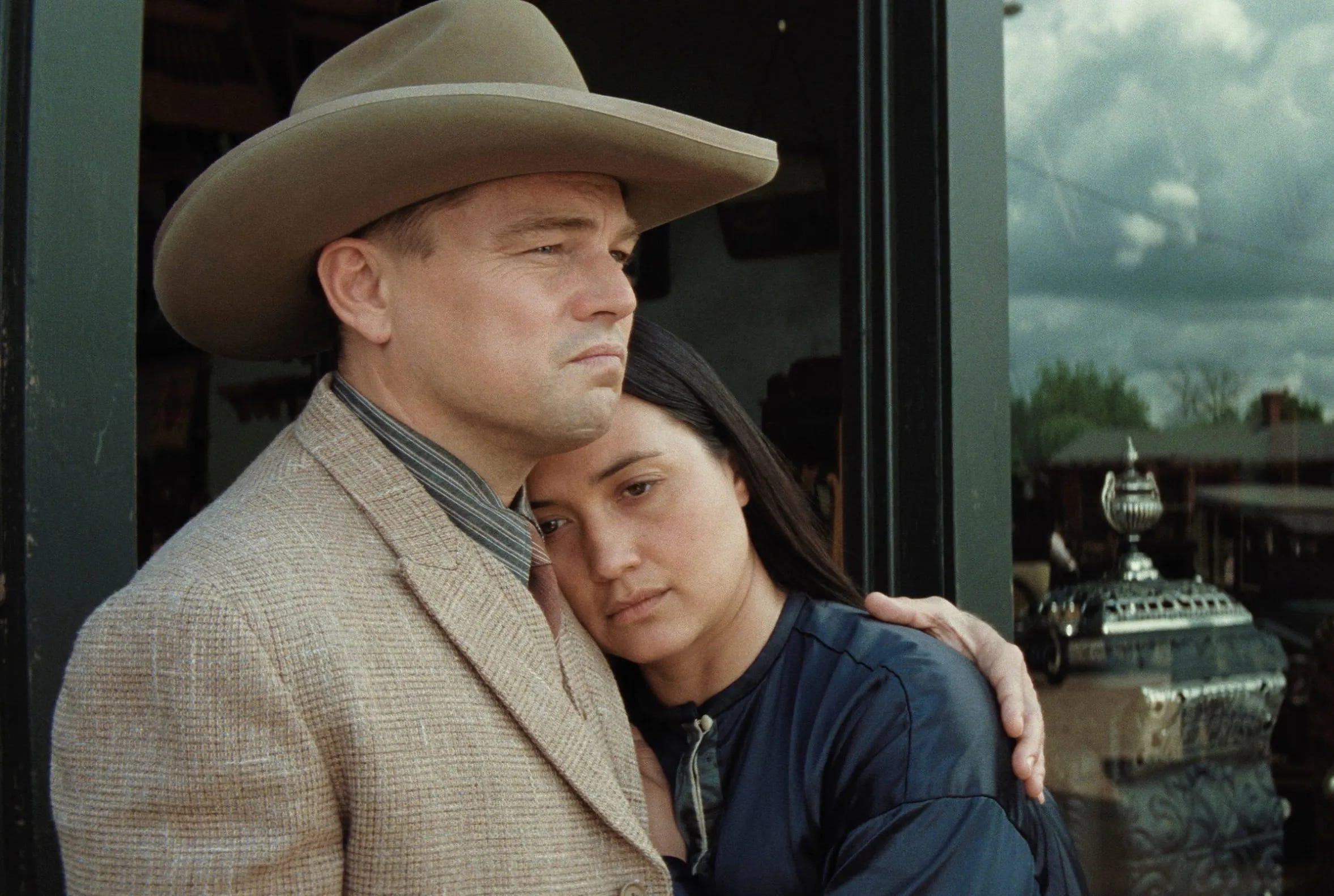
Two hours and thirty minutes in, Hale turns himself in in an attempt to make his arrest appear ludicrous. Afterall, he’s William Hale! How could he have killed anyone? Ernest is questioned and given a deal to testify against his uncle. Now, there’s a sudden shift in the plot. Ernest and others involved in the Osage murders have assumed the roles of victims, replacing the Osage while Hale is the mastermind with wealth and connections, using both along with a stellar reputation and charm to try and get himself out of jail.
Ernest becomes a paranoid boy who was forced into sinful acts by his manipulative uncle. According to Owen Gleiberman for Variety:
Ernest’s actions, in their way, are Mob-like, yet Ernest isn’t presented as a violent man. He’s closer to a moral-idiot manchild who will do whatever his boss uncle tells him to do, because that’s the limits of his thinking.
Gleiberman wonders, just like me, who Ernest Burkhart really is beneath his terrible actions. As I mentioned previously, there’s usually a strong backstory or irrefutable plot twist that makes a hero out of a villain or at least a relatable human out of a troubled character. In Gossip Girl, there was Chuck Bass who with all his entitled, classist and pompous misdeeds, fans connected with, or at least understood better, because of his troubling relationship with his father. As we watch Killers of the Flower Moon, Gleiberman asks just what it is in Ernest that we’re supposed to connect with. But maybe the real answer is that we’re not supposed to connect with a murderous psychopath.
And I would have thought that’s what Scorsese was going for. Ernest is a deluded, money hungry scoundrel who presumably doesn’t realize the severity of his evil, until it faces him in the eye, just to forget about it once more when the money flows in. Considering this is a very true story, it’s even reckless for Scorsese to allow us relate to such a character, even for the sake of storytelling. But then why make Ernest the main character?
In the book written by journalist, David Grann, the chief protagonist is FBI investigator, Tom White. As I watched the film with my sister, we shared similar sentiments of feeling uncomfortable having the villain of a true story take center stage without a true resolution for their crimes. With Ernest in the spotlight, we can’t help but go through his emotional turmoil with him, but because of the taboo of the performance, we also can’t relate to or feel sympathy for him. This isn’t a first for me. Watching Oppenheimer gave me a similar unsettling feeling in my stomach, the kind where I feel no desire to have an opinion on him. We see Oppenheimer through and through as he becomes a 3D character didn’t think far ahead at the results of his actions yet is not absolved of his fault. With Ernest, he appears (appears, because i cannot know with how the story is told) to just be an greedy fool.
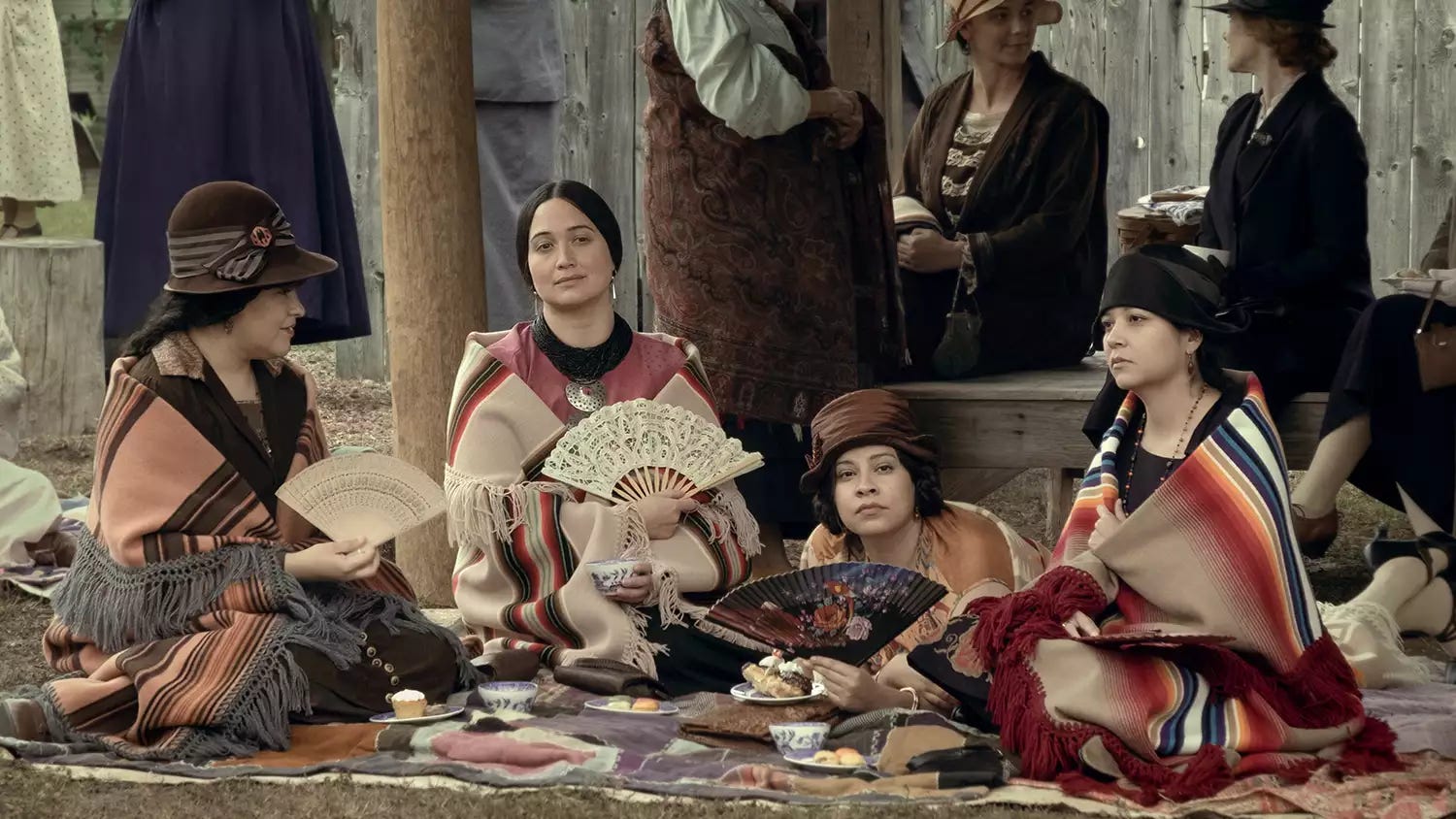
I find Killers of the Flower Moon fascinating in this direction. This story could have been told primarily from Mollie’s perspective. Instead, it chooses to follow the ancient Hollywood formula which places women as secondary characters: wives, lovers, mothers (Mollie is all three throughout the film) meant solely for the development of the male protagonist’s plot. In fact, most of the acting characters are all men. As for the women, they seem to only be reacting to the actions of the male cast. Reta, for example, was just a prop for Bill’s story. Anna, who appeared to have had more agency, was just a plot driver. Henry Roan, Mollie’s first husband, is just a side character but has more character then the leading woman.
Moreover, while Mollie has endured the murder of her family by the one person in the world she should expect nothing but loyalty from, we continue to view the consequences from Hale and Ernest’s perspectives. They have been awarded more complexity than the victim. They are the center of the plot and remain so until the very end. This is worrying because by giving them the power to determine how the story ends, Scorsese also gave them the power to influence how it would be remembered.
The Result of a Failed Bechdel Test
After testifying against his uncle in court, Ernest has a private meeting with Mollie where he asks, ‘How’s my cowboy?’ referring to their son. Mollie, who was saved at the last moment by the Osage, responds, ‘Well’. They continue with this two-bit conversation as Ernest asks about his daughter and if the children know much about what’s going on. Mollie says ‘Not so much’. When Mollie asks if he’s told the whole truth, Ernest simply replies, ‘My soul is clean now, Mollie.’ Then he goes on to say ‘I wasn’t gonna let him get anywhere near you and the children.’ (Hilarious considering we all know this to be a pathological lie). Mollie asks ‘What did you give me?’ (referring to the insulin shots). Ernest replies, ‘Insulin’ and Mollie walks out.
Mollie as a character is 2D. As far as I know, she has no urgent desires and her priority is her safety and the safety of her family, and even this is not allowed her as she places more importance on her love for Ernest. Throughout the second part of the film, we see Mollie look at Ernest as if she knows his big secret. We see her pause in-between their conversations and stare at him with a sort of apprehensive look. But she never addresses the murders. With Ernest away, Mollie is revived and nursed with proper medication at a hospital. They eventually meet and Ernest apologies for all the trouble. In the next scene, he’s surrounded by all those who knew of the scheme and pressured by Hale’s lawyer to accuse the FBI of beating and torturing him. As a simpleton, he agrees. Back home with Mollie, he assures her that it’s all lies and, like a true puppet, says that he was tortured by the FBI to lie against his uncle. Mollie looks at him and simple responds, ‘How long will you be gone?’ At this point, we see clearly that Mollie is a ghost, a shell floating through the screen just like an extra on stage whose movements have no real consequences on the sequence of events.
The plot focus on Ernest belittles the experience of the Osage who remain traumatized till this day, but also reenforces a real-life expectation and stereotype of power dynamics when a white man is in relationship with a woman of color. Even with money, Mollie had no true power. Granted it was the 20s and women rarely had any real power, especially married women, Mollie’s story sees her cling to Ernest through verbal abuse and emotional manipulation that seem to have completely reprogrammed her brain. She could never truly blame him for anything even by the end of the film. All she could do was walk out. Gladstone did a great job of showing Mollie’s emotions on her face, but the character’s perpetual silence until the very end was anti-climatic and left me in an emotional stub.
A more interesting perspective to explore could have been the reliance women feel towards their partners, especially it’s dominance among women of color. But this could only have been possible if it was written /directed by a woman. A great example of this storyline is Sofia Coppola’s Priscilla. In literature, there’s Buchi Emecheta’s Second Class Citizen. Both of these works are written by women and based by real-life events (being auto-biographical). They’re hard to watch/read psychological explorations of manipulation in heteronormative relationships. In Priscilla, Elvis holds power over Priscilla through his seniority in age, economic support and his celebrity. In Second Class Citizen, Adah has the economic advantage as the breadwinner of the family, yet she cannot escape the shadow of her cheating husband who she thanks for giving her children in a culture where she is nothing without a son. She was raised in a society that made her a second-class citizen because she was a woman and endured psychological warfare with herself to escape the anti-normalcy of her arrangement. Both characters, after long internal battles and close calls with death, eventually wake up and free themselves from this male shadow. There’s a clear difference between these characters written by women compared to Mollie’s lackluster and superficial reactions despite also being inspired by real events.
You’re Just a Man
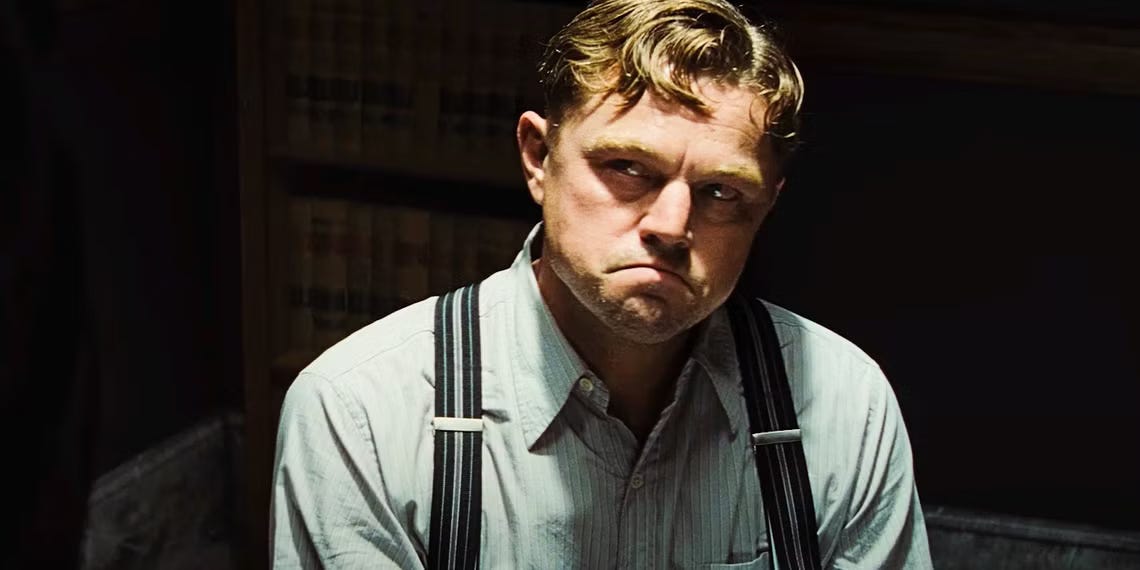
Scorsese’s representation of the redeemed white man irks me as much as it unsettles me. This man who supposedly loves his wife and had no ‘real’ intention of hurting her presents the viewer with a sinister outlook on the world. The silence of the female lead, the expectation of women of color to blindly trust their partners, the forced good nature of the misunderstood white male, all of this could easily slip undetected in a film as beautifully made as Killers of the Flower Moon. This, of course, makes it all the more alarming.
Rather than remain a heartfelt retelling of the Osage murders (which of course it was. A woman who sat beside me in the cinema was in horrible tears just half-way through), Killers of the Flower Moon is thought-provoking in a disheartening way that leaves an unsettling confusion in the mind of its viewers. For such a horrifyingly real story, it is even more horrifying that for one second, viewers are allowed to leave the cinema feeling any form of regret or sympathy for the murderer of a whole clan of Native Americans who attempted to rob them of their rights simply because their assailant is a white man who’s sorry he got caught.